
Online reviews have become one of the most influential factors in shaping customer decisions. Whether someone is looking for a local restaurant, an online store, or a service provider, they often rely on what other customers say before making a purchase. That’s why platforms like Google Reviews and Yelp Reviews continue to play such a critical role in modern business reputation.
But with both platforms offering unique features, and with the digital landscape evolving, it can be challenging for businesses to decide where to focus their efforts. Should you prioritize Google Reviews? Is Yelp still relevant? How do these review sites impact conversions, SEO, and customer trust?
This guide breaks down the key differences between Google Reviews and Yelp Reviews, explores their advantages, and highlights how each platform affects credibility, visibility, and customer acquisition.
1. The Big Picture: Google Reviews vs Yelp Reviews
Both platforms share the same core purpose: helping users discover the best businesses based on real customer feedback. However, the way they collect, show, and rank reviews differs significantly.
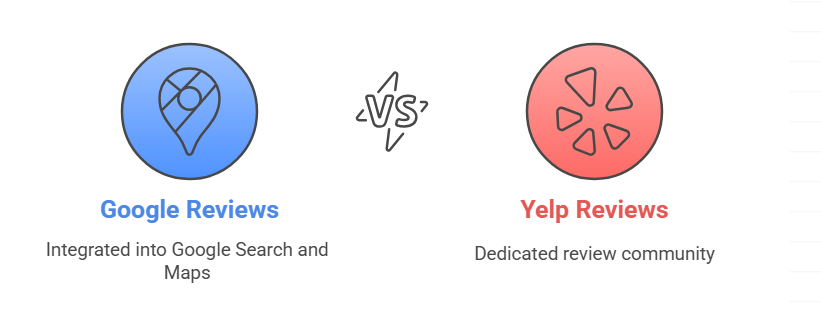
Google Reviews
Google Reviews are integrated directly into Google Search and Google Maps, which means potential customers automatically see star ratings and comments when they look up a business. This gives Google an enormous advantage because the reviews appear at the exact moment customers show interest.
Yelp Reviews
Yelp, on the other hand, positions itself as a dedicated review community. Its platform is especially strong in categories like restaurants, home services, health and beauty, and entertainment. Yelp has cultivated a loyal base of active reviewers, but its influence varies by region and industry.
2. Visibility and SEO Impact
When it comes to visibility, Google clearly dominates due to its integration with search results. For many businesses, especially local ones, Google Reviews are essential for showing up in the Local 3-Pack, the map-based result that appears at the top of many searches.
How Google Reviews Boost SEO
- A higher volume of positive reviews improves local ranking signals.
- Keywords inside reviews support topical relevance.
- Fresh reviews help Google perceive a business as active and trustworthy.
Businesses that strategically display Google Reviews on their websites often see improved credibility and higher conversions. Many brands now use a google review widget to embed authentic customer feedback directly on product pages, service pages, or landing pages.
Yelp’s SEO Impact
Yelp reviews don’t directly influence Google rankings, but Yelp pages themselves often rank well in search results. A strong Yelp profile can still capture traffic, just through a different pathway.
3. User Demographics and Behavior
Understanding who uses each platform can help businesses decide where to put their efforts.
Google Users
Pretty much everyone uses Google. Whether someone is searching for a plumber, a laptop, or a bakery, Google Reviews are the first set of opinions they’ll encounter. This makes Google especially important for:
- Local service businesses
- E-commerce brands (via Google Shopping)
- Hospitality and travel businesses
- Healthcare professionals
The growing popularity of online shopping has also amplified the value of google reviews for ecommerce, as customers increasingly rely on star ratings before purchasing even small products.
Yelp Users
Yelp has a more review-savvy audience. Users tend to be:
- Active reviewers
- Urban professionals
- Food and restaurant lovers
- Service-focused customers
For industries like restaurants, salons, and home services, Yelp can still be a major driver of new clients.
4. Review Filtering and Moderation
Another key difference lies in how each platform moderates reviews.
Google Review Moderation
Google uses automated systems to detect spam, fake reviews, or policy violations. However, it’s relatively easy for customers to leave feedback, no account history needed.
This ease raises concerns about occasional spam or competitor attacks, which is why many businesses use a google review aggregator to track, analyze, and manage reviews across multiple platforms.
Yelp Review Moderation
Yelp is known for aggressive filtering. Reviews from new or inactive users often get hidden under “Not Recommended.” Their algorithm favors:
- Long, detailed reviews
- Regular Yelp contributors
- Verified activity on the platform
While this system aims to maintain authenticity, small businesses sometimes feel frustrated when legitimate 5-star reviews get filtered out.
5. Consumer Trust and Credibility
Both platforms are trusted, but for different reasons.
Why Consumers Trust Google Reviews
- High visibility and accessibility
- Massive volume of reviews
- Quick snapshot of ratings during a search
Google’s widespread use builds automatic credibility. Moreover, google reviews statistics show that customers are 50% more likely to trust businesses with at least 10 recent reviews.
Why Consumers Still Trust Yelp
- Detailed, experience-oriented reviews
- Culture of thoughtful reviewing
- Stricter moderation
Yelp reviewers generally write longer and more descriptive comments compared to the quick star rating often left on Google.
6. Ease of Use for Businesses
Google makes it easy for businesses to:
- Encourage reviews
- Respond to reviews
- Track performance through the Business Profile dashboard
- Share testimonials using a google review widget
With third-party tools, businesses can effortlessly display Google reviews on websites and landing pages.
Yelp
Yelp allows businesses to claim profiles, respond to reviews, and add business info. However, Yelp is more restrictive about asking customers for reviews, discouraging review solicitation to maintain authenticity.
7. Which Platform Drives More Traffic and Conversions?
In most industries, Google wins in sheer traffic and customer impact.
Google Reviews influence:
- Search rankings
- Map visibility
- Consumer trust
- Click-through rates
Because of this, embedding reviews, using a google review aggregator, and encouraging ongoing feedback have become essential digital marketing strategies.
Yelp can still drive meaningful leads in:
- Food and beverage
- Hospitality
- Health and wellness
- Home services (in certain regions)
But its reach isn’t as universal as Google’s.
Final Verdict
If your business can only focus on one platform, the clear winner is Google Reviews. The integration with search results, SEO benefits, ease of use, and large user base make Google the most impactful review platform today.
However, Yelp is far from obsolete. For businesses in industries where Yelp has a strong user community, maintaining an active Yelp profile can still drive high-quality leads.
Best Strategy for Most Businesses
Use both, but prioritize Google.
- Optimize your Google Business Profile.
- Use tools to display Google reviews on your website.
- Add a google review widget for social proof.
- Track feedback using a google review aggregator.
- Keep Yelp updated and respond to reviewers.
By leveraging both platforms, you increase credibility, improve customer experience, and build a stronger online reputation.